Welcome

Welcome to my blog http://www.skegley.blogspot.com/ . CAVEAT LECTOR- Let the reader beware. This is a Christian Conservative blog. It is not meant to offend anyone. Please feel free to ignore this blog, but also feel free to browse and comment on my posts! You may also scroll down to respond to any post.

For Christian American readers of this blog:


I wish to incite all Christians to rise up and take back the United States of America with all of God's manifold blessings. We want the free allowance of the Bible and prayers allowed again in schools, halls of justice, and all governing bodies. We don't seek a theocracy until Jesus returns to earth because all men are weak and power corrupts the very best of them.
We want to be a kinder and gentler people without slavery or condescension to any.

The world seems to be in a time of discontent among the populace. Christians should not fear. God is Love, shown best through Jesus Christ. God is still in control. All Glory to our Creator and to our God!


A favorite quote from my good friend, Jack Plymale, which I appreciate:

"Wars are planned by old men,in council rooms apart. They plan for greater armament, they map the battle chart, but: where sightless eyes stare out, beyond life's vanished joys, I've noticed,somehow, all the dead and mamed are hardly more than boys(Grantland Rice per our mutual friend, Sarah Rapp)."

Thanks Jack!

I must admit that I do not check authenticity of my posts. If anyone can tell me of a non-biased arbitrator, I will attempt to do so more regularly. I know of no such arbitrator for the internet.


Saturday, February 5, 2011

Cpolumbus Dispatch front page 2011 02 05-Spartans

Most Portsmouthites probably see the Columbus dispatch, but you should visit this morning's front page.  I haven't read the story but I didn't enjoy one pic caption's reference to "little crappy town".  Small towns all over America enjoyed their sports esp;ecially throughout the twentieth century.  Portsmouth was a tough town with a tough professional football team. 

I was born in 1932 after the Spartans became the Detroit Lions, and as a blue collar worker's, but a great man's son, I will always love Portsmouth, Ohio. 

Read on, friends, especially Jim Fout (Ashland, KY and  Jack H Plymale (Costa Rica):

Note also:  There are a few pictures included which you should get the Disppatch to see.  I'll try to add the pics a little later this morning.

Sam


A footnote in NFL lore

Sunday's extravaganza between the Packers and Steelers is a direct descendant of a little-known title game in1932 between the chicago Bears and the Spartans Of Portsmouth,Ohio

Saturday, February 5, 2011 02:50 AM

By Todd Jones


The Columbus Dispatch


PrO FOOTBALL HALL OF FAME

Portsmouth's 3-year-old NFL team lost to the Bears in 1932 in an unscheduled title game forced indoors by a winter storm in Chicago. The league's first postseason game broke a tie atop the standings; its success during the Depression prompted an annual title game.


BROOKE L aVALLEY
DISPATCH

Spartan Municipal Stadium, named a state historical site in 2003, should be preserved, says the Portsmouth Spartans Historical Society. Envisioning ghosts of pros of 80 years ago are, from left, Randy Nickles, Paul O'Neill and Jim Kennedy.

Pro Football Hall of Fame


The 1932 NFL playoff drew 11,000 fans indoors to Chicago Stadium to see the Bears defeat the Portsmouth Spartans 9-0 on an 80-yard field. Excited by the size of the crowd, owners of the 10 teams created two divisions for the 1933 season to allow for an annual title game.

BROOKE L aVALLEY
DISPATCH

A NFL logo is taped to the refrigerator in the Portsmouth stadium's visitors locker room. The aging structure is still used for football, but razing it has been discussed.
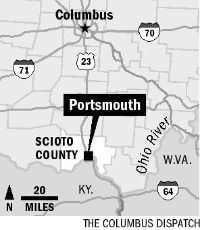

PORTSMOUTH, Ohio - Once home to an NFL team, the simple structure now looks its age of 81 years. The concrete grandstands are cracked and chipped. Wrought-iron gates creak when opened. Rust stains the light poles. The weathered Spartan Municipal Stadium is an antithesis of the gleaming, $1.2 billion football palace in Arlington, Texas, that will host Super Bowl XLV between the Pittsburgh Steelers and Green Bay Packers on Sunday.


Although the 3 million-square-foot Cowboys Stadium reflects today's NFL and its annual revenue of $7.8billion, Portsmouth's old field by an Ohio River floodwall is a testament to the league's humble, small-town roots.


Spartan Municipal Stadium was home to the Portsmouth Spartans when they played in the fledgling NFL for four seasons, beginning in 1930, at a time when the league's office was in Downtown Columbus.


Hear the sound of a nearby train, and you can imagine those Spartans traveling to Chicago to play for the NFL championship on Dec.18, 1932. They didn't call it the Super Bowl or even a championship game when visiting Portsmouth lost to the Chicago Bears in the league's first postseason game.


Two years later, the Spartans left town. The NFL churned on, leaving behind an era when Ohio had nine cities with franchises - including Columbus, Cleveland, Cincinnati, Toledo, Dayton, Akron, Canton and LaRue - playing in the league at various times from 1920 to 1934.


Proud history at Spartan Municipal Stadium provides visitors with brief refuge from the harsh economic realities that have ravaged once-booming Portsmouth, the seat of Scioto County, and its 11.7 percent unemployment rate.


Visitors gaze at the footprints on the snow-covered field about 90 miles south of Columbus and see the ghosts of leather-helmeted players taking Portsmouth to the precipice of a world championship.


"It makes you proud to say that this little, crappy town once had an NFL team that played with the big boys," said Jim Kennedy, a member of the Portsmouth Spartans Historical Society.


Hard times in town

A tattered American flag flies above the tallest building in downtown Portsmouth, where voters overwhelmingly decided in December to recall Mayor Jane Murray in the first year of a term that began with her firing several city administrators.


She is the second mayor since 2004 to be recalled in financially strapped Portsmouth, which is battling dysfunction on many levels.


Portsmouth's population topped 42,000 when the Spartans played here.


Today, about 21,000 live in the city. Chipped paint and boarded-up storefronts on Chillicothe Street, the city's main thoroughfare, scar a place once known as the "Peerless City" because it had everything going for it.


Portsmouth's steel and other manufacturing industries created so much optimism in 1929 that residents voted to fund a bond issue to build a new football stadium, which enabled the Spartans to join the NFL a year later.


Two years after that, Portsmouth and Chicago ended the regular season with the same winning percentage; at the time, the NFL used that statistic - ties didn't count - to determine its champion. NFL president Joe Carr, a Columbus native, honored the requests of the Bears (6-1-6) and Spartans (6-1-4) to decide the 1932 championship on the field.


Bears owner George Halas and Spartans owner Harry Snyder also hoped another gate receipt would help their teams' red-ink finances, hurt by the Depression. Each winning player received $240; losers were paid $175.


Portsmouth could afford to take only 16 players to Chicago. The Spartans were missing Earl "Dutch" Clark, their quarterback, punter and kicker. The future Pro Football Hall of Fame enshrinee didn't play because the game wasn't on the regular schedule, and he had already committed to coach basketball at Colorado College.


"That says a lot about pro football at the time," said Joe Horrigan, vice president at the Pro Football Hall of Fame. "He got paid more to coach basketball."


An unusual title game

A stench literally surrounded the NFL's first postseason game.


The Spartans and Bears were scheduled to play at Wrigley Field, but a winter storm blew in. Fearing a small crowd because of the inclement weather, Halas moved the game indoors to Chicago Stadium, which had dirt and dung on its floor from hosting a circus a few days earlier.


"The players said you could smell that there had been animals in there," said Chris Willis, head of the research library at NFL Films and author of Old Leather, an oral history of early football in Ohio.


Sod, bark and wood shavings were added to the dirt "field," which was shortened to 80 yards because of the arena's configuration. Players said footing was treacherous. Both offenses were slowed by the conditions, and field goals weren't allowed because of the low-hanging ceiling.


Portsmouth squandered two chances for first-half touchdowns. The game was scoreless in the fourth quarter when two NFL legends hooked up for Chicago: Bronko Nagurski threw a 2-yard TD pass to Red Grange.


The Spartans argued to no avail that Nagurski had broken a rule in place then that passes had to be thrown from at least 5 yards behind the line of scrimmage. Chicago later added a safety for a 9-0 win.


The Bears, however, weren't officially awarded the championship until two months later at a league meeting.


Team owners, still buzzing about how the Portsmouth-Chicago game drew 11,000 fans, wanted a repeat in the 1933 season. So the 10-team league split into eastern and western divisions, with the winners meeting in an official NFL championship game. Today, it's the Super Bowl.


The owners also adopted three rules changes because of the Portsmouth-Chicago playoff game. They moved the goal posts up to the goal line, allowed passers to throw from anywhere behind the line of scrimmage, and established hash marks for field position.


"That game in particular opened their eyes to make the game more entertaining and different than the college game," said Willis, a Columbus native.


A more-open style of play came too late to save the Spartans. They had battled financial woes since operating as a semipro team in 1929 and joining the NFL a year later. The team faced a $27,000 debt after two seasons.


"It was the height of the Depression, and people couldn't pay for tickets," Willis said. "Unfortunately, there weren't enough fans in Portsmouth."


Desperate for revenue, the Spartans scheduled a game in December 1933 against the Pittsburgh Pirates (now the Steelers) to be played in Columbus at Red Bird Stadium (now Cooper Stadium). An ice storm canceled the game. Portsmouth never played another official one.


A radio executive bought the franchise for $16,000 in 1934. The Spartans moved to Detroit and were renamed the Lions, leaving Green Bay as the NFL's only small-market team.


Detroit won the 1935 NFL championship with the Spartans' former coach, Potsy Clark. Many of that team's players were once cheered in Portsmouth, where time is melting their legend.


"I work with a lot of young guys," Kennedy said, "and when I tell them we had an NFL team, they say, 'What?'"


New stadiums elsewhere

Numerous metal signs throughout downtown point visitors to Front Street, where civic pride sparkles along a 2,000-foot stretch of concrete wall.


Portsmouth put murals on the floodwall in the early 1990s to depict the city's history, and the 20-by-35-foot paintings give life and color to the nearby small, vibrant section of town called the Historic Boneyfiddle District.


One of the 66 murals is of another famous 1932 game in which Clark defiantly refused to substitute as his Spartans beat the defending NFL champion Packers. Recently, however, that depiction of players in the "The Iron Man Game" had to be temporarily removed because of water damage.


While the Spartans' mural awaits new paint, the Super Bowl buildup rages on in Texas. The mega-event's flash is reflected in the shiny buildings of downtown Dallas, not far from where the Packers and Steelers will play in a game projected to generate $600 million for that area's economy.


Our nation is riveted by the Super Bowl: Last year's game was the most-watched American television program in history, drawing 106.5million viewers. Places such as Portsmouth grapple with the cold, hard reality of outsiders' lack of interest.


The city reportedly has a $1.2 million deficit. Last year, the water and sewer systems fell out of compliance with environmental regulations. Black mold was discovered in the city building. Portsmouth had three major water-main breaks in December.


"We're in disarray," said Paul O'Neill, a member of the Portsmouth Spartans Historical Society, as he stood in empty Spartan Municipal Stadium on a gray winter day.


The NFL's past swirled around him. Dutch Clark and Gene Alford played on this field. So did Roy "Father" Lumpkin, so tough that he refused to wear a helmet, and Glenn Presnell, an All-Pro who died in 2004 at age 99, the last of the Spartans.


Beyond the concrete grandstand, where fans cheered the Spartans to a 19-2-4 home record in their four NFL seasons, lies the faded downtown of Portsmouth, once a leading U.S. shoe producer that also had a bevy of steel mills and the largest railroad yard east of the Mississippi.


"We don't even have a department store here anymore," Kennedy said. "If you need cologne, you've got to go to Columbus."


Portsmouth factories closed in the 1970s. The steel industry suspended local operations in 1981. Marting's, a 100-year-old family-owned retailer, went out of business. The old Norfolk & Western rail depot was torn down, as were several other landmarks.


"Most towns try to preserve that stuff. Portsmouth just levels it," Kennedy said.


In recent years, city officials have debated razing Spartan Municipal Stadium because of safety concerns and upkeep costs.


A short drive away is the new Portsmouth High School football stadium, opened in 2009 as part of an athletic complex built by the school system. Most of its $10 million cost was covered by a private donation from the Clark Foundation.


"This is where the $10million should have gone - to refurbish this place," Kennedy said as he stood inside Spartan Municipal Stadium, designated a state historical site in 2003.


The city-owned facility remains the 6,287-seat site of home games of Portsmouth Notre Dame High School and a semipro football team from across the river in Kentucky.


And it's where some men go to see the past to smile in the present.


"Everybody thinks new is better," O'Neill said. "Man, just look at the history here."


tjones@dispatch.com

Friday, February 4, 2011

Reagan understood America- o has no clue! Sam

Reagan understood America's greatness resides in its people

Friday, February 4, 2011 02:51 AM

By Cal Thomas


On the centenary of Ronald Reagan's birth, I pause for another historic event: agreement with President Barack Obama, who says of his predecessor in USA Today: "Ronald Wilson Reagan was a believer ... he recognized that each of us has the power - as individuals and as a nation - to shape our own destiny.


He had faith in the American promise; in the importance of reaffirming values like hard work and personal responsibility; and in his own unique ability to inspire others to greatness."


Precisely!


I suspect Reagan would be embarrassed by the attempts to elevate him to political sainthood. Even conservatives who now long for another Reagan were sometimes critical of him during his presidency and of those around him they believed were holding him back. "Let Reagan be Reagan" they cried, as if he wasn't who he was.


What made Reagan a great president was that he understood America and his countrymen better than any politician of his time, or perhaps any time. He saw that the greatness of the country is not found in Washington, no matter which party or personality is in power. Rather, it is to be found in the people. Reagan awakened that dormant truth.


Reagan didn't need to be president to complete himself. He knew who he was before seeking the job. Self-awareness is an essential quality in a leader if he or she is to avoid the siren call of narcissism and the temptations that go with the preoccupation about "legacy."


Reagan awakened in many Americans the belief that no matter what the challenge, Americans can meet it. His opponents mocked him for what they regarded as an old-fashioned concept. In a time of growing dependency on government, based on the fallacy that we can't do much on our own (and if we do, we must be punished with higher taxes and more regulation), such a notion was offensive to the dominant political culture. Reagan tapped into a principle that is as much a part of our DNA as motherhood and the American flag.


Reagan's "vision for America" mirrored our vision of ourselves: strong internationally, economically sound at home. He restored our self-confidence at a time when his predecessor, Jimmy Carter, was suggesting America had seen its best days and we should trim our expectations and become "realists."


Reagan, the eternal optimist, even after discovering he had Alzheimer's disease, was always thinking about the future. Bill Clinton made the future his theme when he adopted Fleetwood Mac's Don't Stop (Thinking About Tomorrow) as his 1992 campaign song. After reading a book about Reagan, Obama tried to channel him in his State of the Union address. It fell flat.


Trying to be Reagan without the substance didn't fully succeed with Clinton, either, because of his self-absorption, manifested in the sex scandals. It is even less likely to succeed with Obama because his big-government philosophy is the antithesis of Reaganism. A theme must have more than a melody. It must be in harmony with America. Reagan's was. Obama is off-key.


A Google search for Reaganisms finds scores of little phrases that touched principles handed down by previous generations of Americans. These aphorisms were born of Reagan's own experiences with FDR Democrats and the notion that the bigger government gets, the fewer liberties we enjoy.


Here are just three: "We have a deficit, not because the government taxes too little, but because it spends too much"; "Above all, we must realize that no arsenal, or no weapon in the arsenals of the world, is so formidable as the will and moral courage of free men and women. It is a weapon our adversaries in today's world do not have"; " ... there are great advantages to being elected president. The day after I was elected, I had my high-school grades classified Top Secret." Self-deprecation and humility rested comfortably on Reagan's broad shoulders.


Reagan didn't promise to do great things for us. He showed us that great things came from within us. Modern Republicans would do well to remind themselves that America's greatness doesn't lie within politicians, but within each of its citizens. That is Reagan's legacy.


Cal Thomas writes for Tribune Media Services.

Thursday, February 3, 2011

Places to retire... Thanks Sarah Rapp!

Subject: Fwd: Places to retire


? Here are some of your choices:


You can retire to Phoenix , Arizona where...

1. You are willing to park 3 blocks away because you found shade.

2. You've experienced condensation on your hiney from the hot water in the toilet bowl.

3. You can drive for 4 hours in one direction and never leave town.

4. You have over 100 recipes for Mexican food.

5. You know that "dry heat" is comparable to what hits you in the face when you open your oven door.

6. The 4 seasons are: tolerable, hot, really hot, and ARE YOU KIDDING ME??!!


OR


You can retire to California where...

1. You make over $250,000 and you still can't afford to buy a house.

2. The fastest part of your commute is going down your driveway.

3. You know how to eat an artichoke.

4. You drive your rented Mercedes to your neighborhood block party.

5. When someone asks you how far something is, you tell them how long it will take to get there rather than how many miles away it is.

6. The 4 seasons are: Fire, Flood, Mud, and Drought.


OR


You can retire to New York City where...

1. You say "the city" and expect everyone to know you mean Manhattan .

2. You can get into a four-hour argument about how to get from Columbus Circle to Battery Park, but can't find Wisconsin on a map.

3. You think Central Park is "nature."

4. You believe that being able to swear at people in their own language makes you multi-lingual.

5. You've worn out a car horn. (Ed. Note if you have a car).

6. You think eye contact is an act of aggression.


OR


You can retire to Minnesota where...

1. You only have four spices: salt, pepper, ketchup, and Tabasco .

2. Halloween costumes fit over parkas.

3. You have more than one recipe for casserole.

4. Sexy lingerie is anything flannel with less than eight buttons.

5. The four seasons are: winter, still winter, almost winter, and construction.


OR


You can retire to the Deep South where...

1. You can rent a movie and buy bait in the same store.

2. "Y'all" is singular and "all y'all" is plural.

3. "He needed killin" is a valid defense.

4. Everyone has 2 first names: Billy Bob, Jimmy Bob, Mary Sue, Betty Jean, Mary Beth, etc.

5. Everything is either "in yonder," "over yonder" or "out yonder." It's important to know the difference, too.


OR


You can retire to Colorado where...

1. You carry your $3,000 mountain bike atop your $500 car.

2. You tell your husband to pick up Granola on his way home and so he stops at the day care center.

3. A pass does not involve a football or dating.

4. The top of your head is bald, but you still have a pony tail.


OR


You can retire to the Midwest where...

1. You've never met any celebrities, but the mayor knows your name.

2. Your idea of a traffic jam is ten cars waiting to pass a tractor.

3. You have had to switch from "heat" to "A/C" on the same day.

4. You end sentences with a preposition: "Where's my coat at?"

5. When asked how your trip was to any exotic place, you say, "It was different!"


OR


FINALLY You can retire to Florida where.

1. You eat dinner at 3:15 in the afternoon.

2. All purchases include a coupon of some kind -- even houses and cars.

3. Everyone can recommend an excellent dermatologist.

4. Road construction never ends anywhere in the state.

5. Cars in front of you often appear to be driven by headless people.

Food Stamps... Thanks Dr. Hovermale!

Last Updated:February 3 @ 03:33 pm

By Kay Daly February 2, 2011 8:38 pm


Text Size: A A A


Like most government welfare programs, food stamps was meant to be a last resort in desperate times for those who have had drastic difficulties with their financial situation. It was never meant to be a program from cradle to grave nor was it to be a generational thing, passed down like a precious antique. (For a real eye opener on the whole subject of welfare programs, check out Marvin Olasky's "The Tragedy of American Compassion." It will change your entire perspective on the subject of what real help is...and what is just downright cruel, despite what the liberals claim!)


The Wall Street Journal sadly noted today that 43 million Americans are on food stamps. The state with the smallest percentage of citizens on food stamps is Wyoming and the "state" with the largest percentage collecting food stamps? The District of Columbia. So within the shadow of the Capitol dome, more than one fifth of the District's population is on food stamps.


Like most welfare programs, the lottery and nearly anything that the government seems to get involved in, the program actually hurts those it claims to help.


Not only does it trap recipients into a lifestyle that is hard to extract oneself from, not only it is a generational cancer that grows, spreads, and eats any kind of ambition, determination and motivation alive, but it also steers recipients toward some of the worst food habits on the planet. Have you ever seen the items on the approved list for food stamps? High in preservatives, fats, sodium, chemicals and carbs -- these are the quick food solutions that seem "cheaper" and boy are they engineered to taste swell. But they are building eating habits in generations of children that will be devastating to their health.


Perhaps they are thinking they can just take care of the results of the food stamp program with Obamacare!


In all seriousness, there are children out there who are eating their way into a shortened life span who have never seen a fruit or a vegetable that didn't come out of a can or a frozen bag. The sodium level alone in most of the food stamp approved premade foods and quick prepare foods are sky high. The sugar level in the packaged drinks approved for the food stamp program would keep a child on the ceiling for most of the school day.


Obesity program, Mrs. Obama? Take a good long look at the laughable nutrition standards in the food stamp program and what folks are actually buying and you'll see a whale of a correlation to obesity.


Rating: 9.3/10 (87 votes cast)

Why muslims are the way they are... Thanks Les!

This is the best explanation I've ever heard as to why Muslims are


they way they are!

Begin forwarded message:


Sent: Sat, Jan 29, 2011 8:55 am

Subject: Muslim Inbreeding

Interesting read, and it's not a joke. Some might say the finding is no less than obvious.


A Huge Muslim Problem: Inbreeding

By Bryan Fischer


Nicolai Sennels is a Danish psychologist who has done extensive research into a little-known problem in the Muslim world: the disastrous results of Muslim inbreeding brought about by the marriage of first-cousins.


This practice, which has been prohibited in the Judeo-Christian tradition since the days of Moses, was sanctioned by Muhammad and has been going on now for 50 generations (1,400 years) in the Muslim world.


This practice of inbreeding will never go away in the Muslim world, since Muhammad is the ultimate example and authority on all matters, including marriage.


The massive inbreeding in Muslim culture may well have done virtually irreversible damage to the Muslim gene pool, including extensive damage to its intelligence, sanity, and health.


According to Sennels, close to half of all Muslims in the world are inbred. In Pakistan , the numbers approach 70%. Even in England , more than half of Pakistani immigrants are married to their first cousins, and in Denmark the number of inbred Pakistani immigrants is around 40%.


The numbers are equally devastating in other important Muslim countries: 67% in Saudi Arabia, 64% in Jordan, and Kuwait, 63% in Sudan, 60% in Iraq, and 54% in the United Arab Emirates and Qatar .


According to the BBC, this Pakistani, Muslim-inspired inbreeding is thought to explain the probability that a British Pakistani family is more than 13 times as likely to have children with recessive genetic disorders. While Pakistanis are responsible for three percent of the births in the UK , they account for 33% of children with genetic birth defects.


The risk of what are called autosomal recessive disorders such as cystic fibrosis and spinal muscular atrophy is 18 times higher and the risk of death due to malformations is 10 times higher.


Other negative consequences of inbreeding include a 100 percent increase in the risk of stillbirths and a 50% increase in the possibility that a child will die during labor.


But the most devastating consequence of Muslim marriage tradition and patterns, and most worrisome to non-Muslims, is the lowered intellectual capacity. According to Sennels, research shows that children of consanguineous marriages lose 10-16 points off their IQ and that social abilities develop much slower in inbred babies.


The risk of having an IQ lower than 70, the official demarcation for being classified as "retarded," increases by an astonishing 400 percent among children of cousin marriages.


(Similar effects were seen in the Pharaonic dynasties in ancient Egypt and in the British royal family, where inbreeding was the norm for a significant period of time.)


In Denmark, non-Western immigrants are more than 300 percent more likely to fail the intelligence test required for entrance into the Danish army.


Sennels says that "the ability to enjoy and produce knowledge and abstract thinking is simply lower in the Islamic world." He points out that the entire Arab world translates just 330 books every year, about 20% of what Greece alone does.


In the last 1,200 years of Islam, just 100,000 books have been translated into Arabic, about what Spain does in a single year. Seven out of 10 Turks have never even read a book.


Sennels points out the difficulties this creates for Muslims seeking to succeed in the West. "A lower IQ, together with a religion that denounces critical thinking, surely makes it harder for many Muslims to have success in our high-tech knowledge societies."


Only nine Muslims have ever won a Nobel Prize, and five of those were for the "Peace Prize." According to Nature magazine, Muslim countries produce just 10 percent of the world average when it comes to scientific research (measured by articles per million inhabitants).


In Denmark, Sennels' native country, Muslim children are grossly overrepresented among children with special needs. One-third of the budget for Danish schools is consumed by special education, and anywhere from 51% to 70% of retarded children with physical handicaps in Copenhagen have an immigrant background.


Learning ability is severely affected as well. Studies indicated that 64% of school children with Arabic parents are still illiterate after 10 years in the Danish school system. The immigrant drop-out rate in Danish high schools is twice that of the native-born.


Mental illness is also a product. The closer the blood relative, the higher the risk of schizophrenic illness. The increased risk of insanity may explain why more than 40% of the patients in Denmark 's biggest ward for clinically insane criminals have an immigrant background.


The U.S. is not immune. According to Sennels, "One study based on 300,000 Americans shows that the majority of Muslims in the USA have a lower income, are less educated, and have worse jobs than the population as a whole."


Sennels concludes:


There is no doubt that the widespread tradition of first cousin marriages among Muslims has harmed the gene pool among Muslims. Because Muslims' religious beliefs prohibit marrying non-Muslims and thus prevents them from adding fresh genetic material to their population, the genetic damage done to their gene pool since their prophet allowed first cousin marriages 1,400 years ago are most likely massive. [This has produced] overwhelming direct and indirect human and societal consequences.


Bottom line: Islam is not simply a benign and morally equivalent alternative to the Judeo-Christian tradition. As Sennels points out, the first and biggest victims of Islam are Muslims. Simple Christian compassion for Muslims and a commonsense desire to protect Western civilization from the ravages of Islam dictate a vigorous opposition to the spread of this dark and dangerous religion. These stark realities must be taken into account when we establish public polices dealing with immigration from Muslim countries and the building of mosques in the U.S.


Let's hope America wakes up before a blind naiveté about the reality of Islam destroys what remains of our Christian culture and our domestic tranquility.


Bryan Fischer - Focal Point

The Kiss... Uh Oh, Clay Vice!

A tough looking group of bikers were riding when they saw a girl about to jump off a bridge so they stop.


The leader, a big burly man, gets off his bike and says, "What are you doing?"


"I'm going to commit a suicide," she says.


While he did not want to appear insensitive, he didn't want to miss an opportunity he asked "Well, before you jump, why don't you give me a Kiss?"


So, she does and it was a long, deep lingering kiss.


After she's finished, the biker says, "Wow! That was the best Kiss I have ever had. That's a real talent you are wasting. You could be

famous


Why are you committing suicide?"


"My parents don't like me dressing up like a girl......"

Only a man would attempt this... Thanks Clay Vice!

I thought you might get a kick out of this one, if you haven't already seen it.


ONLY A MAN WOULD ATTEMPT THIS

Just try reading this without laughing till you cry!!!


Pocket Tazer Stun Gun, a great gift for the wife. A guy who purchased his lovely wife a pocket Tazer for their anniversary submitted this:


Last weekend I saw something at Larry's Pistol & Pawn Shop that sparked my interest. The occasion was our 15th anniversary and I was looking for a little something extra for my wife Julie. What I came across was a 100,000-volt, pocket/purse-sized Tazer.


The effects of the Tazer were supposed to be short lived, with no long term adverse affect on your assailant, allowing her adequate time to retreat to safety...??


WAY TOO COOL! Long story short, I bought the device and brought it home... I loaded two AAA batteries in the darn thing and pushed the button. Nothing! I was disappointed. I learned, however, that if I pushed the button and pressed it against a metal surface at the same time, I'd get the blue arc of electricity darting back and forth between the prongs.


AWESOME!!! Unfortunately, I have yet to explain to Julie what that burn spot is on the face of her microwave.


Okay, so I was home alone with this new toy, thinking to myself that it couldn't be all that bad with only two AAA batteries, right?


There I sat in my recliner, my cat Gracie looking on intently (trusting little soul) while I was reading the directions and thinking that I really needed to try this thing out on a flesh & blood moving target.


I must admit I thought about zapping Gracie (for a fraction of a second) and then thought better of it. She is such a sweet cat. But, if I was going to give this thing to my wife to protect herself against a mugger, I did want some assurance that it would work as advertised.


Am I wrong?


So, there I sat in a pair of shorts and a tank top with my reading glasses perched delicately on the bridge of my nose, directions in one hand, and Tazer in another..


The directions said that: a one-second burst would shock and disorient your assailant;


a two-second burst was supposed to cause muscle spasms and a major loss of bodily control; and


a three-second burst would purportedly make your assailant flop on the ground like a fish out of water.


Any burst longer than three seconds would be wasting the batteries. All the while I'm looking at this little device measuring about 5" long, less than 3/4 inch in circumference (loaded with two itsy, bitsy AAA batteries); pretty cute really, and thinking to myself, 'no possible way!'


What happened next is almost beyond description, but I'll do my best.


I'm sitting there alone, Gracie looking on with her head cocked to one side so as to say, 'Don't do it stupid,' reasoning that a one second burst from such a tiny lil ole thing couldn't hurt all that bad.. I decided to give myself a one second burst just for heck of it.


I touched the prongs to my naked thigh, pushed the button, and..


HOLY MOTHER OF GOD. WEAPONS OF MASS DESTRUCTION. WHAT THE... !!!


I'm pretty sure Hulk Hogan ran in through the side door, picked me up in the recliner, then body slammed us both on the carpet, over and over and over again I vaguely recall waking up on my side in the fetal position, with tears in my eyes, body soaking wet, both nipples on fire, testicles nowhere to be found, with my left arm tucked under my body in the oddest position, and tingling in my legs! The cat was making meowing sounds I had never heard before, clinging to a picture frame hanging above the fireplace, obviously in an attempt to avoid getting slammed by my body flopping all over the living room.


Note: If you ever feel compelled to 'mug' yourself with a Tazer, one note of caution:


There is NO such thing as a one second burst when you zap yourself! You will not let go of that thing until it is dislodged from your hand by a violent thrashing about on the floor! A three second burst would be considered conservative!


A minute or so later (I can't be sure, as time was a relative thing at that point), I collected my wits (what little I had left), sat up and surveyed the landscape.


My bent reading glasses were on the mantel of the fireplace. The recliner was upside down and about 8 feet or so from where it originally was. My triceps, right thigh and both nipples were still twitching. My face felt like it had been shot up with Novocain, and my bottom lip weighed 88 lbs. I had no control over the drooling. Apparently I had shit in my shorts, but was too numb to know for sure, and my sense of smell was gone. I saw a faint smoke cloud above my head, which I believe came from my hair. I'm still looking for my balls and I'm offering a significant reward for their safe return!


PS: My wife can't stop laughing about my experience, loved the gift and now regularly threatens me with it!


This email was cleaned by emailStripper, available for free from http://www.papercut.biz/emailStripper.htm

Blog Definition

On Line Blog Definition
Google-Blog Definitionblog, short for web log, an online, regularly updated journal or newsletter that is readily accessible to the general public by virtue of being posted on a website.